


Faustian Bargain? No Thanks!
Introduction · Chapters · About the book
Escaping the Prison of Toxic Passions
I share my experiences from Rwanda in 1994. These “lessons learnt from ground zero” highlight what can happen when the internal moral compass fails. Two great traditions come to our aid.
A Terrifying Sight
What is the worst possible consequence of polarisation? Once, a long time ago, I saw it with my own eyes.
In the first chapter of my book, Adventures and Reflections, I recount the experiences I had while travelling in Rwanda during the genocide of 1994. I describe a journey with a rebel officer who showed a place where people had been killed. Walking among the corpses is a harrowing experience, I can assure you. From the chapter:
I looked to the right and to the left. Even more corpses. How many? [...] One hundred, two hundred, three hundred? It was impossible to count.
The chapter ends with a reflection on God, evil and the meaning of life.
I Visit a Prison and Meet the Killers
In the second chapter of the book, I recount my visit to a Rwandan prison, where the prisoners guilty of the atrocities were held. It was two years after the genocide. The prison was absolutely overcrowded, with many more prisoners than it was built to hold.
One of them showed me around and I spoke to some of them. To my surprise, they were quite friendly. In the prison yard I saw a group of prisoners singing while one of them conducted. After a while I realised that it was the church choir rehearsing for the Sunday Mass.
This puzzled me. Were these really the men who had committed such terrible atrocities? Why were they such easy prey to evil?
A Rwandan man who had participated in the killings, but felt deep remorse, said in a newspaper interview: “You were praised and respected when you killed Tutsis. You were proud. We were all brainwashed to think that if we didn’t kill the Tutsis, they would kill us.”
Flattery and fear, in other words. Without an inner defence against toxic passions, something begins to break. Integrity cracks – and the soul goes up for sale. Clever demagogues and agitators seize the opportunity to manipulate and control. They have no use for qualities such as compassion and good judgment.
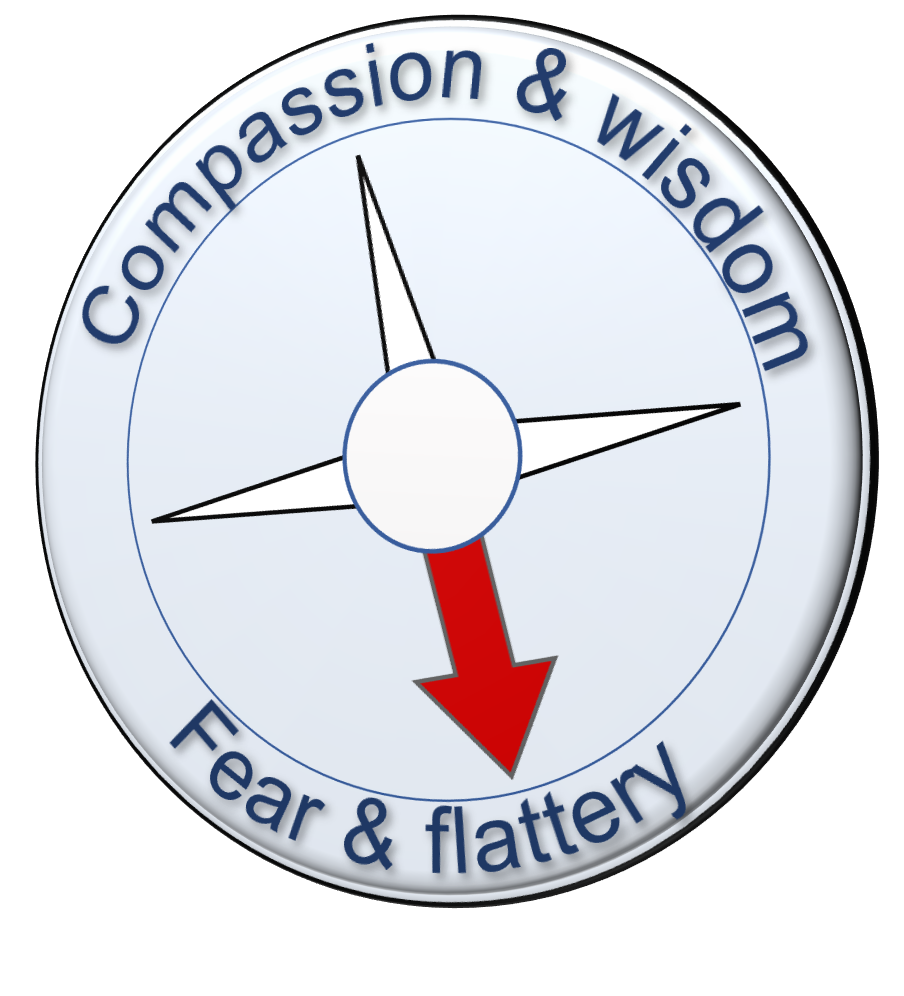
The visit to the prison astonished me. How could such seemingly nice and kind people become so cruel and brutal in certain situations? Was this a collection of extremely sick individuals? Or were they human beings, not very different from us?
I think they are more like us than we would like to admit. The problem of fear, anger and hatred concerns us too. Who is completely immune to the great driving force of evil – the intoxicating sense of power? Does anyone have an inner compass that works perfectly?
A misaligned compass can create hell on earth and lead to a spiritual prison. We need to be guided more by wisdom and compassion.
What makes us human?
But where does this inner compass come from? Are we born with it, or must it be shaped?
The Rwandan prisoners were not born murderers. Something in their upbringing – or the lack thereof – had left them vulnerable. This raises a deeper question: what actually shapes a person’s moral compass, and how does this differ from simply teaching someone to obey?

There is a fundamental difference between training an animal – like a dog – and nurturing the growth of a human being. A dog may be unruly at first, but with rewards and punishment, it can be moulded into well-behaved conduct. It learns to wag its tail at familiar faces and to bark at strangers.
Reward and punishment may be necessary to train early behaviour, but they can never forge character. Unlike animals, human beings are capable of moral development – shaped by reason and compassion rather than by rewards and punishments. Integrity cannot be imposed from without; it must be nurtured from within.
But what happens if we raise a child as if it were a dog? At best, the child may become well-behaved – but without a genuine sense of right and wrong. It may learn to “bark” at strangers simply because they are different. It will lack an inner moral compass.


Dopamine Compass vs. Logos Principle
What feels right isn't always true. What feels pleasant isn't always good. This confusion is an age-old trap. The brain doesn't always want what's best for us.
The human brain has a built-in reward and punishment system. When we succeed at something, dopamine is released – a neurotransmitter that gives us a sense of satisfaction. When we fail, however, a feeling of discomfort is created to hold us back. It's a kind of biological carrot and stick.
But what if we get a dopamine rush from listening to gossip about others? Or when we feel schadenfreude that someone we dislike runs into trouble? Or when we hate and despise a certain group? Or when we get intoxicated by a sense of control and power? It feels pleasant in the moment – but it isn't necessarily good.
Our biological reward system is simply not a reliable moral compass. The prefrontal cortex is – roughly speaking – our biological seat of reason, self-control, and empathy. Like a muscle, this control centre needs constant exercise to prevent it from atrophying. It's not about suppressing every dopamine impulse, but about creating balance in the system.
People already had a sense of this in ancient times. Aristotle, of course, did not know the anatomy of the brain. He did not use terms like “neuroplastic reprogramming.” But he understood exactly what it's all about: the importance of forming good habits and practicing virtue. This is a loaded term, associated with moralizing and self-righteousness. But this is precisely what much of sound child-rearing is all about: learning not to act on every impulse immediately.
But virtue and impulse control must be directed toward something, a yardstick outside ourselves. The ancient Greeks had a word for this: Logos – a divine principle of order and a reason that transcends our fleeting emotions. For Christians, Logos is more personal and associated with Christ – a spiritual model, a blueprint toward which we can orient ourselves.
In a culture devoid of Logos, people reject the idea that there is something above us to which we must conform. In such a culture, emotion itself becomes the standard: What feels right is true; what feels pleasant is good. This is sometimes the case, but far from always.
This confusion manifests itself, for example, in right-wing populism, which thrives on scapegoating, mistrust, hatred, and contempt. They believe in demagogues who can say and do absolutely anything. The fact that these figures lie constantly and act shamelessly is the very appeal – because it creates a dopamine rush.
Left-wing populism isn't much better. Activists often fall into the trap of externalizing blame. The villains are always “the others” – the structures, the system, the opponents. This isn't necessarily wrong, but placing all responsibility outside oneself can be an escape – from the realization that we ourselves might be driven by pleasurable hatred, the desire for revenge, and the need for power. With such driving forces, there can be no real change.
Entire societies can get stuck in this trap: what is right and wrong is determined by the dopamine compass. Such a culture is not free. It is obvious that we need a Logos principle; the question is, what kind?
Logos can be understood as certain abstract ideals. But the purity of these ideals often leads to disgust and contempt for imperfect people who do not live up to them. Even if the ideals are “tolerance” and “humility,” people will despise those who are not tolerant or humble enough. The same applies to democracy, science, and the Enlightenment. The ideals are good, but idealism undermines it all. Virtue is about practice – not about adorning oneself with fancy medals.
The Two Great Logos Traditions
There are two traditions that seek to align humanity with Logos. They are usually symbolized by “Athens” and “Jerusalem.” Athens stands for philosophy, reason and learning. Jerusalem represents faith, spirituality and hope.
The ancient Greek thinkers encouraged self-reflection. “Know thyself,” they said. Socrates believed that a life without self-reflection – an “unexamined life” – is meaningless. Plato, Aristotle, and the ancient Stoics held that Logos – the divine principle of order and reason – is essential for our growth and development as human beings.
A Christ-Logos is personal and a voice from another world. It is patient and kind. It is not puffed up. It keeps no record of wrongs, but rejoices with the truth. When the brain's loud signals fall silent, we can begin practising what is true and good. Then we become part of the epic drama of existence: Logos becomes flesh and dwells among us.
Athens and Jerusalem—two voices, two paths, two legacies that have carried generations through the centuries. Those who embrace one and reject the other may well do so. But those who listen to both will soon discover that they are not enemies but allies. United, they become stronger than they are separately.
Next, we will take a closer look at the seven classical virtues. Faith, hope, and love come from Jerusalem. Wisdom, justice, moderation, and courage come from Athens. Together, they form a bulwark against the darkest passions.
ONE POSSIBLE ANSWER
Share in a group chat:
Visit ErikPleijel.com