


Faustian Bargain? No Thanks!
Chapter 7 · Chapters · About the book
Strength: Keep Your Head up When Everything Goes Wrong
Authoritarian leaders gain popularity by appearing strong and tough. However, ancient Stoic philosophy reveals that they are deeply weak and fragile.
The West Must Rediscover Its Compass
The ideas of the Greeks were passed on to the Romans, who developed a philosophy called Stoicism. It is relevant to those who want to be grounded in reality and work for the common good. Stoic philosophy contains some ideas that belong to an outdated worldview, but also things that are timeless.
It is in many ways embedded in Christianity. Many of the Christian church fathers, and probably St Paul, were influenced by the Stoics. Luther, Melanchthon and Erasmus had one thing in common: all three liked the writings of Cicero, which contain many Stoic ideas.
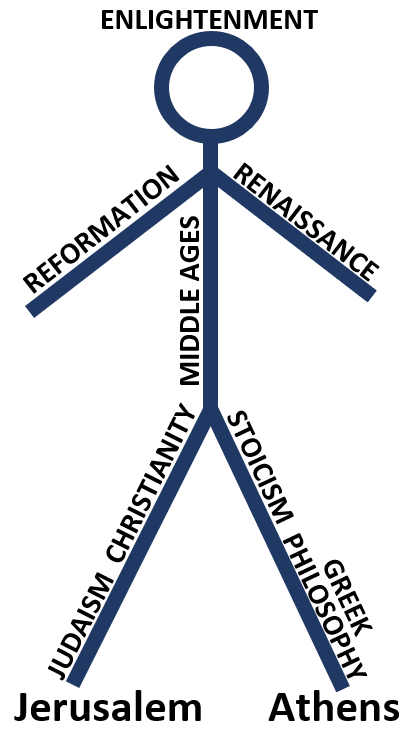
Alf Ahlberg wrote: "The humanist tradition is based above all on a fusion of Stoicism and Christianity". He argued that the Western humanist tradition has been shaped by a number of religions, philosophies and epochs. It developed during the Middle Ages, the Renaissance, the Reformation and the Enlightenment. Its ancient roots lie in Judaism, Christianity, Greek philosophy and Stoicism. He wrote that this is "the great line of our culture, on whose existence and vitality its whole future depends".
The synthesis of Stoicism and Christianity is the origin of a precious treasure: the belief in human rights. This idea has matured and developed throughout history. This was mainly done by Cicero in antiquity, and then by Christian philosophers such as Thomas Aquinas in the Middle Ages, and Locke and Kant in the Enlightenment.
There are times when the West seems to have completely lost its moral compass. That is when we need to reconnect with our historical and spiritual roots.
The Courage to Be Gentle
A common misconception is that stoicism leads to an emotionless, cold state of mind. Its essence is self-awareness and self-control – which is why CBT (Cognitive Behavioural Therapy) can be seen as its modern heir. Taken to extremes, stoicism hardens into callousness, but held in balance it builds inner health.
Some young men today see themselves as culture warriors on a mission to rescue Western civilisation from decadence. A common trait is that they mistake dialogue and empathy for weakness. The irony is that what is presented as strength is often just brittleness in disguise.
True strength needs no performance of toughness. Stoic discipline is not about suppression of feeling but its governance.
When stoicism meets Christian love, strength finds its proper direction. It gives rise to the courage to be gentle without fear – to listen, to remain open to argument, and to be assertive without becoming defensive. That is real strength.
Training Exercises for the Soul
The ancient Stoics were inspired by the philosophy of Socrates, which included the idea that it is better to suffer wrong than to do wrong. They saw him as an example of how to live in a stormy world with inner peace and without corrupting one's soul.
The Stoics believed that man's most precious possession was the integrity of the soul. This means that external things such as success and wealth are less valuable. This can be compared with Jesus' statement: "What does it profit a man if he gains the whole world but loses his soul?"
The Stoic Epictetus saw God as a primal force that creates an inner strength in the soul. The Serenity Prayer is rooted in his philosophy.
The Serenity Prayer
God, grant me the serenity to accept the things I cannot change, courage to change the things I can, and wisdom to know the difference.
Most of what happens in the world is beyond our control, but what we can control are our reactions, said Epictetus. We can control our opinions, desires and aversions. For a Stoic, it is important to maintain an inner peace of mind that is independent of external circumstances. You must not allow yourself to be enslaved by base thoughts.
"We have nothing to fear but fear itself", said Franklin D. Roosevelt. The ability to feel fear is, of course, absolutely vital. We live in a dangerous world and if we couldn't feel fear, we would put ourselves in dangerous situations unnecessarily. What Roosevelt warned against is a fear that impairs judgement. Dangers and threats must be assessed with a balanced mind that neither overreacts nor cowardly closes its eyes to reality. We must be careful that fear does not lead to delusion, tunnel vision or blindness.
The trials and tribulations of everyday life can become exercises in keeping your balance. Epictetus gave the following advice to someone visiting a bathhouse (in the Roman Empire around 100 AD):
For example, if you are going to take a bath, think about what happens in a bathhouse: people splash each other, push each other, fight and steal from each other. You will be safer if you say to yourself: "I am going to have a bath and at the same time maintain my natural equilibrium." You should do this before everything you do. If something disturbs you while you are bathing, you will have the idea that "I intended not only to bathe but also to maintain my natural balance, and I can't do that if I am disturbed by what is happening now".
According to Stoicism, it is important to be able to think negatively and try to imagine unpleasant surprises. This may sound like pessimism, but it is actually optimism. It's like saying to yourself: "Even if I encounter difficulties and setbacks, I have an inner readiness to deal with the problems".
For a Stoic, it is particularly important to reflect on one's mortality and to be grateful for the life one has. This puts the world into a truer perspective.
It is important, however, that these Stoic exercises are not overdone. It should not lead to emotional coldness, indifference and an inability to care. Feelings of frustration and anger can be important motivators. The main thing is that anger does not become a pleasure and an unrestrained habit.
Power Does Not Always Corrupt
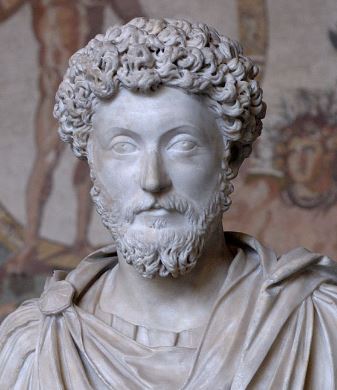
It is often said that power corrupts and absolute power corrupts absolutely. However, it seems that there is one exception and that is the emperor and stoic Marcus Aurelius. He had unlimited power to do whatever he wanted, but he tried hard to resist the temptation.
A Stoic sets limits to himself and his actions – not everything that can be done should be done – and has enough self-discipline to respect those limits. Power does not provide freedom from the burden of following principles.
"Beware of being a tyrant," Marcus said to himself. "So be honest, good and upright, love justice, be pious, be kind and loving, and be steadfast in the discharge of duty."
Those who have power over others must first have self-awareness and self-control. This philosophy of life is relevant to politicians, civil servants, police officers, managers and others whose duty it is to serve a higher ethic and the common good.
Why be honest if it is more profitable to be corrupt? This was Glaucon's challenging question in The Republic. Socrates' answer was illuminating. A healthy body has value in itself. The same is true of the soul. The soul of the unjust is sick, while the soul of the just is healthy. Inner health has an intrinsic value, even if it is not always "profitable".
Justice is the defence against the idea that might is right. There are those who say they are fighting for justice, when in fact they are fighting for power and revenge. This is what happens when one lacks inner justice. The struggle for justice is both an inner and an outer struggle.
Anger can be the driving force to fight against injustice, but what about hate? It is important to learn to distinguish between these emotions. Hate can cause suffering to others and it can seriously damage your own intellect. It is wise to make this a rule of life: Anger may be OK, but hate is not. It is a matter of setting limits for yourself and learning not to cross them.
Two Forms of Acceptance
Stoicism has experienced a true renaissance in recent years. It has re-emerged as a guide for modern life. But something often gets lost in its popular form. It has to do with two different ways of accepting difficulty. Call them trust-based acceptance and will-based acceptance.
The first is closer to what the Stoics originally meant: a way of life grounded in virtue, duty to society, and surrender to a rational, divine Logos. For Marcus Aurelius and Epictetus, Stoicism was not just a tool for achieving personal success. When they told themselves to accept their fate, they were not gritting their teeth against an indifferent universe. They were trusting it. Their acceptance rested on something outside themselves: the sense that “this is happening within a rational universe of which I am a part.” It still took daily practice, but the effort was aimed at trust.
The modern pop-stoicism has a tendency to be stripped down into a self-help toolkit. It is used as a life-hack for personal optimization, emotional suppression and worldly success – rather than duty to the human community. This lacks the soul of the original philosophy, which was Logos-centred. Strip away Logos, and acceptance has nothing left to rest on. You have to generate the motivation yourself – telling yourself, I choose to accept this because it's good for my character. It is less like resting and more like clenching the fist. It requires sheer willpower rather than trust. In the end it becomes exhausting.
Hope When Everything Seems to Go Wrong
The Christian belief in life after death can lead to a pious escape from the world, but it doesn't have to be that way. On the contrary, it can become a source of inner strength. Hope protects us from emptiness and cynicism.
Heavenly hope gives the feeling of having a home. It creates a natural stoicism that is not forced or contrived. Even if everything goes wrong, all is not lost. Hope becomes an inner source, which is less dependent on circumstances. The heavenly hope can therefore also create an earthly hope. Bonhoeffer wrote:
Optimism is in its essence not an opinion about the present situation but a living force, a power to hope where others give up, a power to hold one's head up high where everything seems to fail, a power to bear setbacks, a power that does not leave the future to the pessimist but claims it for hope. Admittedly, there is a cowardly and foolish optimism that should be discarded. But optimism as a desire for the future is not to be despised, even if it is wrong a hundred times over; it is the health of life, which the sick must not contaminate. There are people who consider it a lack of seriousness, Christians who consider it a lack of piety, to hope for a better earthly future and to prepare for it. They believe in chaos, disorder and catastrophe as the order of the day, and in resignation or pious escapism they shirk responsibility for the continuation of life, for restoration, for the next generation. It may be that the Day of Judgement comes tomorrow, in which case we should gladly let go of the work for the future, but not before.
ONE POSSIBLE ANSWER
💬 Share to a group chat 🌱
Share in a group chat:
Visit ErikPleijel.com