


Faustian Bargain? No Thanks!
Chapter 9 · Chapters · About the book
Impartiality: The Invisible Bond That Holds the World Together
Many are drawn to the vision of a purely religious society. But this is an idea that risks corrupting faith through power and privilege.
A Dangerous Dream
"Christian nationalism" contains an inner contradiction: Christianity is about learning humility, while nationalism revolves around pride, which at times tips over into arrogance. It is not necessarily an impossible combination – but it does require that we avoid a particular trap.
Christian nationalism is the dream of a unified nation held together by a strong sense of identity and belonging. But the dream can turn into a nightmare when the power of the state is used to enforce the vision. At that point, it is no longer about community, but about excluding, reshaping, or even erasing whatever does not fit. Ruthlessness is built into the project. In that sense, Christian nationalism can become radically un-Christian.
Many imagine "the secular" as an atheistic project designed to push faith into the private sphere. But nothing could be more mistaken. In fact, the secular – paradoxical as it may sound – is a deeply Christian idea.
The historian Tom Holland describes in his book Dominion how it all began with Jesus' words: "Give to Caesar what belongs to Caesar, and to God what belongs to God." In that sentence lay the seed of a revolutionary idea.
In the ancient world, religion and politics were inseparable. There was no boundary, no distance, no neutral zone. The ruler ruled by divine authority, and the state existed by religious justification. Only slowly did Christians begin to realise that these spheres should not be merged but kept distinct. That insight was refined over centuries – through the medieval struggle between pope and emperor, through the Reformation's distinction between spiritual and worldly authority, and through Enlightenment ideas about freedom.
No one knows exactly where the line should be drawn, but the basic principle is clear: there must be a neutral zone where faith is not turned into a tool of power. The secular state creates breathing space that protects faith from being corrupted by political privilege.
This must not be confused with secularisation, the process by which religion gradually loses influence over society and daily life. The secular state is instead about how we manage the charged relationship between faith and power. Properly understood, it serves as an important safeguard against religious coercion – and just as importantly, against atheist coercion.
Making Room for the Golden Rule
That society is permeated by Christian values is not a problem in itself – and in many ways, it already is. Jesus sums up the law in the Golden Rule: "Whatever you wish that others would do to you, do also to them." This principle of reciprocity underpins much of our modern legal order.
Perhaps the most Christian thing we can do is to safeguard this so that it is not undermined by various religious supremacy projects. We must never use the resources and laws of the state to gain privileges over, for example, Jews, Muslims, or non-believers.
For when faith becomes a path to power and status, we sell our soul in a Faustian pact. The faith then turns into something bribed, twisted, and eventually hollow.
The secular state does not dilute faith – quite the opposite. It makes it possible for Christians to actually live as Christians in society and to practice the Golden Rule.
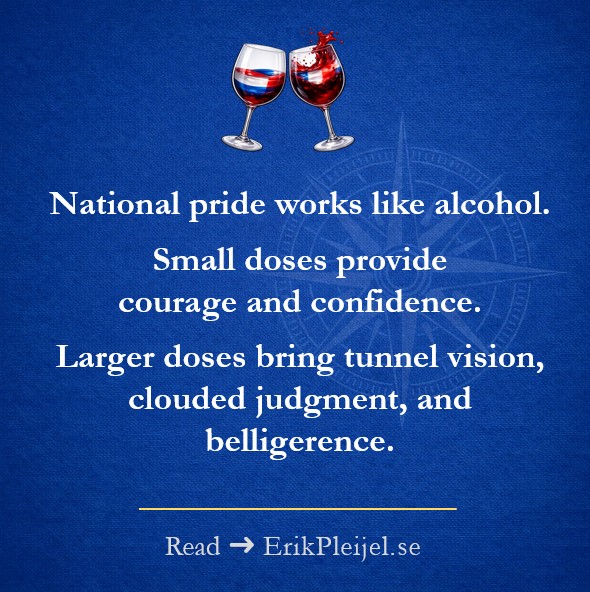
It is also about exercising moderation. National pride works much like alcohol. In small doses it can give courage and strengthen self-confidence. In larger doses, judgment becomes clouded. Eventually we grow harsh and aggressive. When this is mixed with religious self-righteousness, it creates a toxic cocktail that hardens the heart and destroys judgement.
Of course, there is a healthy form of national pride grounded in moderation. Such pride and identity should rest on the idea of a secular and neutral state. This is an ancient heritage, shaped in many ways by Christian tradition, and one we ought to preserve and develop. It protects not only strangers and minorities. It also protects us Christians – especially from ourselves.


Who Cheers for the Referee?
One of the healthier expressions of nationalism and tribalism is football. In this game people rally behind their own team. There are passionate chants, songs, and cheering. But who cheers for the referee? Nobody. He moves through the game as a thankless, almost invisible presence – whistling, pointing, occasionally ruining your joy. He is often the subject of mockery and resentment. If he does a good job, you soon forget he existed. He inspires no devotion.
And yet, without him, there is no game. Nobody thinks, 'He is doing a poor job, therefore we don't really need a referee.' Remove the referee, and the game grows more violent. Before long, it doesn't even resemble football anymore.
The team is the object of devotion. But behind all the passion lies the realisation that the game is entirely dependent on someone that nobody loves: the referee. We all understand this instinctively, even if we have never put it into words.
We also understand that there must be someone that appoints the referee. There must be a national football association setting the rules, appointing officials, and handling appeals. And above that, international bodies like FIFA. These organisations are faceless, bureaucratic, occasionally corrupt – and absolutely necessary. Despite all the scandals surrounding FIFA, nobody seriously suggests that it should not exist. The question is never whether we need governing bodies, only whether they are doing their job honestly.
The football world is, in miniature, a model of something much larger. Every functioning society has referees – regulators, courts, international bodies. They are unglamorous by design. Their role is not to play the game but to make the game possible. The better they do their job, the less we notice them.
Rules, laws and procedures rarely inspire much enthusiasm. They interrupt us, restrain us, slow us down. They say 'no' when we want 'yes', and 'wait' when we want 'now.' Just like the referee standing in the middle of the match, they are unpopular and often the target of discontent. We notice them most when they disappoint us.
Remote and faceless institutions are seldom the object of affection. Who sings hymns about the World Trade Organization? Who writes poems about the International Atomic Energy Agency?
And yet, without neutral institutions, there is no life as we know it. They are what make freedom possible in practice. The ability to trust a total stranger – to sign a contract, board a plane, drink the water, accept a banknote – is a quiet miracle. We do not think much about it. But we should.
If these institutions are removed, what remains is not freedom, but chaos and violence. States and institutions are becoming increasingly like mafias.
Populists are like football fans that have taken their hatred of the referee to another level. All these faceless, bureaucratic and, at times, corrupt institutions should be torn down. It never dawns to them that they destroy the game they love.
We don't have particularly warm feelings towards these institutions – they're not something we 'like'. What is needed is a different kind of love: care, responsibility and vigilance. They must be staffed by honest and competent people. Every functioning society depends on their quiet work, even when it is hard to understand and far removed from our daily lives.
All this is an expansion of the commitment to the secular state and the Golden Rule. Impartiality and reciprocity mean that the same standards apply – the powerful and the weak alike. A rules-based order is a trust-based one. It creates an invisible bond that holds the world together.
In Service of Something Higher
This is a commitment we need to make: reason, dialogue, and rules are far better than the alternative – a battle of wills, coercion, manipulation. We need a firm belief in Logos.
Some will object: “Yes, we need reason, a rule-based world order – but why the metaphysical talk, why the god-talk? We can do very well without that.”
That's surely possible. But remember how will-based acceptance soon drains your energy, while trust-based acceptance lets you endure. There's an example of how that could work.
Few have embodied the calling of universal reason as fully as Dag Hammarskjöld. The Swedish diplomat served as UN Secretary-General from 1953 until his death in a plane crash over the Congo in 1961 – in service to the very end.
He understood that once he took the oath of office, he was no longer loyal to a nation, but to the Truth. He was not to serve Sweden, or the West, or any "coalition of the righteous," but the UN Charter. Once he put on the robe of the referee, he was not allowed to take sides.
The demands of that role were high: impartiality towards special interests, courage to withstand pressure from the superpowers, respect for law and truth, just-mindedness that answered to principle rather than power, integrity even when it cost him. It was a selfless service that erases the ego. These are the classical virtues dressed in institutional clothing.
He was no starry-eyed idealist. He was a hard realist who saw the unsettling truth: these institutions are the only bulwark against the abyss of might-makes-right. "The UN was not created to take mankind to heaven, but to save humanity from hell," he famously said.
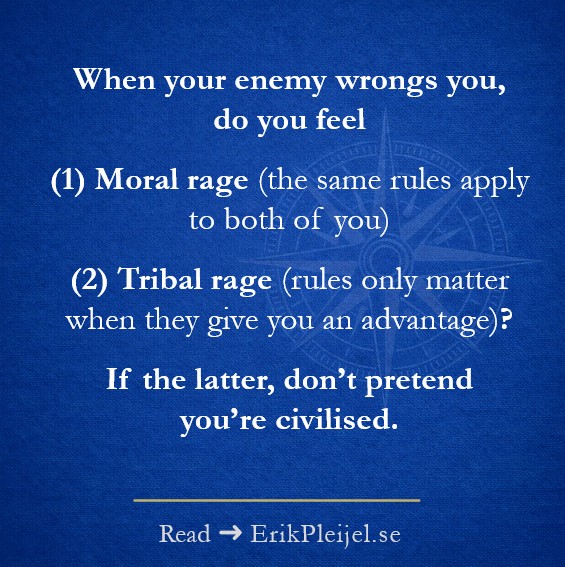
This is what it means to be civilised: the rejection of double standards and the application of one standard for all. The real clash is not between civilisations, but between a civilised game and uncivilised chaos.
But he was no soulless bureaucrat. He was able to bear the weight of his role thanks to a deeply contemplative inner life – as one can read in his 'Markings'. These writings reveal that, in his private life, he was devoted to God. His introspective, mystical, trust-based Christianity did not provide him with a group identity. Instead, it gave him the strength to devote his life to something greater than himself – God in private, and the Truth and the Charter in public.
ONE POSSIBLE ANSWER
💬 Share to a group chat 🌱
💬 Share to a group chat 🌱
Share in a group chat:
Visit ErikPleijel.com